Bracket
Also called Fillet
The curved transition where a serif meets its stem, and the difference between a Clarendon and a plain slab.
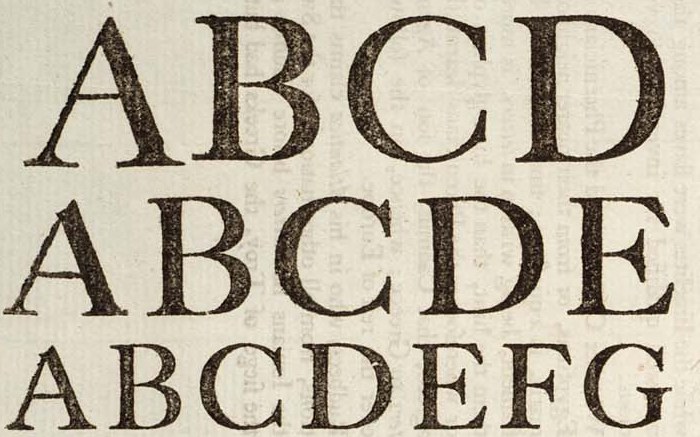
Public domain
Public domain: Caslon's broadsheet of about 1734, out of copyright everywhere since Caslon died in 1766; Commons tags the file public domain and a faithful photograph of a flat sheet carries no new copyright; this crop is the three lines of large capitals at the top left. Shown from outside the house on purpose: a stroke in this foundry's faces carries one width for its whole path, so a bracket, a serif flaring into its stem, cannot be cut here.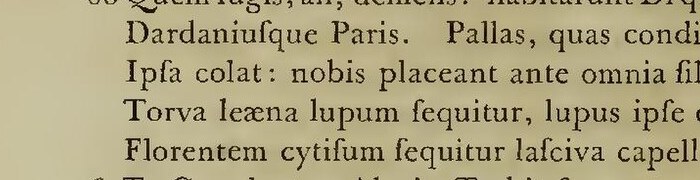
Public domain
Public domain: Baskerville's Virgil of 1757, out of copyright everywhere since Baskerville died in 1775; Commons tags the scan public domain and a faithful scan of a flat page carries no new copyright; this crop is three lines of the Eclogues at the page's own resolution.Near it
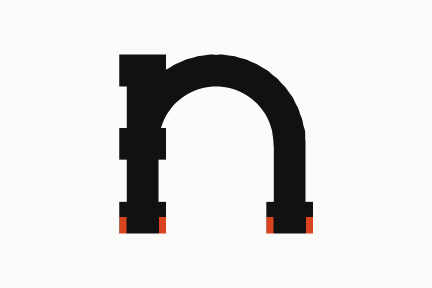 Serif
Serif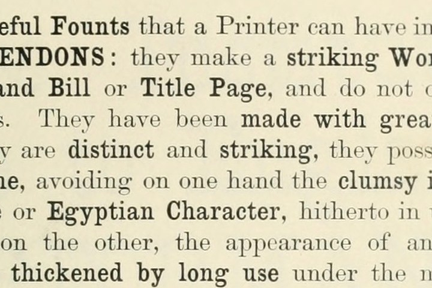 Clarendon
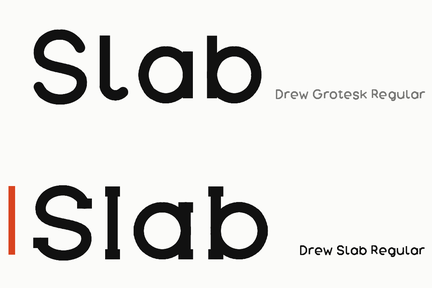 Slab serif
What it is made of
| NOT MEASURED ON THIS SHELF, and here is what it would take | the curve joining a serif to a stem. NOT answerable from the skeleton alone: a bracket is made by the stroker where two strokes meet, so it needs the stroker's own join geometry as well | THE INSTRUMENT IT WOULD NEED, and it is not an image measurement. Every glyph on this shelf is drawn from STROKES - a centreline and a width, every one a line or a circular arc. Recovering this part from a filled outline is image analysis done to get back something the house already holds in source. The measurement is a reader for those skeletons, and it would answer most of the nine at once. |